







Artificial Intelligence in 2026: How AI Is Reshaping Every Major Industry
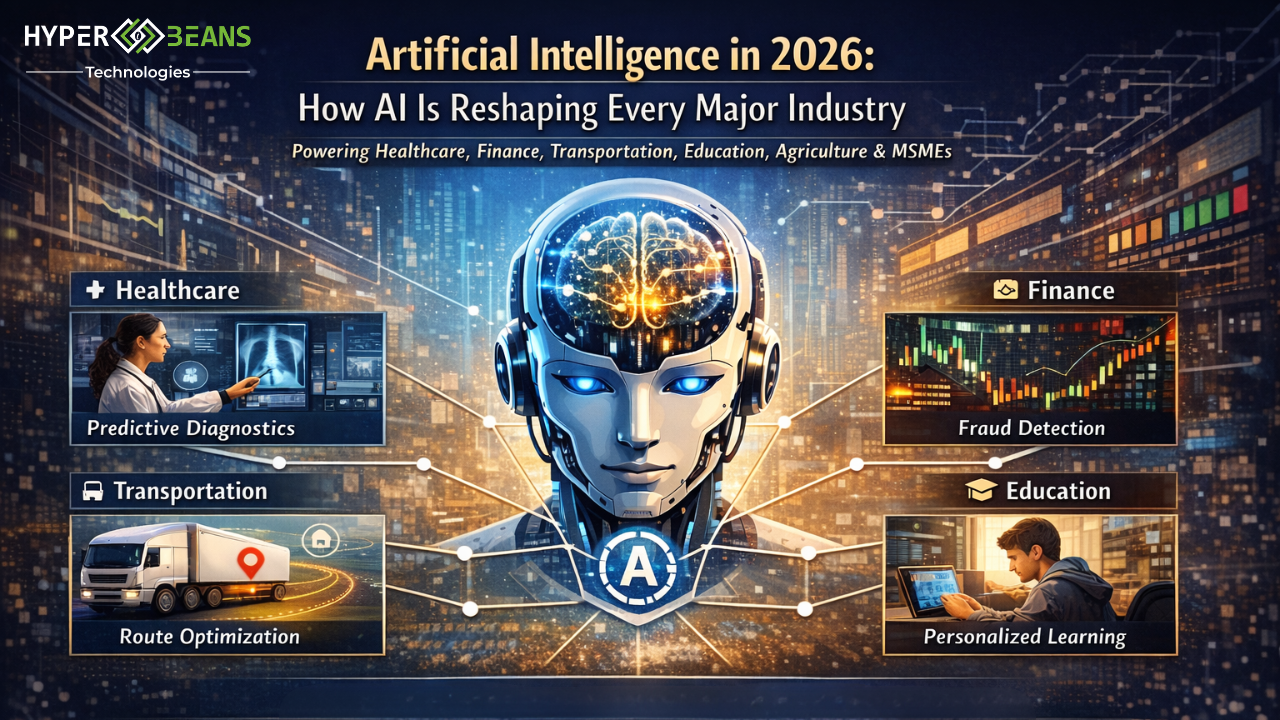
Artificial Intelligence in 2026 is a business infrastructure layer powering decision-making across healthcare, finance, transportation, education, agriculture, and MSMEs. Companies are using AI to reduce costs, increase operational speed, and improve predictive accuracy.
According to McKinsey, nearly 88% of enterprises now use AI in at least one function. The global AI market is projected to surpass $400 billion within the next few years, reflecting rapid enterprise integration.
This article explains how AI is transforming major industries, what measurable ROI looks like, and how businesses are successfully adopting AI systems.
What Is Driving AI Adoption in 2026?
AI adoption is accelerating due to:
-
Exponential growth in enterprise data
-
Rising operational costs
-
Increased demand for real-time personalization
-
Competitive pressure for automation
Organizations are shifting from reactive workflows to predictive decision systems powered by machine learning and advanced analytics.
AI in Healthcare: Predictive and Precision-Driven
AI in healthcare is used for diagnostic imaging, predictive patient monitoring, and workflow automation.
The AI healthcare market is projected to exceed $45 billion by 2026. AI-assisted imaging tools can improve anomaly detection accuracy by up to 20% in specific use cases.
Hospitals adopting AI typically begin with:
-
Predictive risk monitoring
-
Administrative automation
-
AI-assisted diagnostics
-
Real-time clinical decision systems
Business Impact:
Reduced read missions, faster diagnosis, and 20–35% operational efficiency improvements.
AI in Finance: Real-Time Risk Intelligence
AI in finance supports fraud detection, credit scoring, and automated compliance.
More than 70% of financial institutions use AI-driven fraud detection systems. Machine learning models reduce false positives by up to 90%, lowering operational costs and improving accuracy.
Banks usually deploy AI in stages:
-
Customer support chatbots
-
Fraud detection algorithms
-
Predictive credit scoring
-
Algorithmic portfolio management
Business Impact:
Faster approvals, lower risk exposure, improved compliance efficiency.
AI in Transportation: Operational Optimization at Scale
AI in transportation enhances route optimization, fleet maintenance, and demand forecasting.
AI-driven route optimization can reduce fuel costs by 15–25%. Predictive maintenance decreases downtime by up to 40%.
Logistics companies integrate:
-
Telematics data
-
Predictive maintenance models
-
Demand forecasting engines
-
Semi-autonomous operations
Business Impact:
Reduced costs, improved delivery performance, higher asset utilization.
AI in Education: Personalized Learning Systems
AI in education enables adaptive learning and automated assessment.
The AI education market is expected to reach $25 billion by 2030. Adaptive systems increase student engagement by 15–30% by tailoring learning pathways to individual performance data.
Institutions begin with:
-
AI recommendation engines
-
Automated grading
-
Predictive performance tracking
Business Impact:
Higher engagement, reduced administrative workload, data-driven academic planning.
AI in Agriculture: Precision and Forecast Intelligence
AI in agriculture supports yield prediction, crop monitoring, and irrigation optimization.
The AI agriculture market is projected to reach $4 billion by 2026. Precision farming tools increase crop yields by 10–20% in optimized environments.
Adoption often starts with IoT sensors and drone imaging before expanding into predictive analytics and automated irrigation.
Business Impact:
Improved yield accuracy, resource efficiency, stronger supply chain forecasting.
AI in MSMEs: High-Impact, Fast ROI
AI is increasingly accessible to small and medium enterprises through cloud platforms.
Over half of MSMEs now experiment with AI tools in marketing automation, sales forecasting, and inventory management.
AI marketing systems can increase conversion rates by up to 30%, while predictive inventory models reduce stock mismanagement by 20–25%.
Business Impact:
Immediate cost savings, better customer targeting, scalable growth.
How AI Rapidly Transforms Industries
AI adoption typically follows four maturity levels:
-
Task automation
-
Predictive analytics
-
Decision support systems
-
End-to-end workflow optimization
Organizations advancing beyond automation into predictive and autonomous intelligence create sustainable competitive advantages.
How Businesses Successfully Implement AI
Successful AI deployment requires:
-
Defining measurable ROI use cases
-
Building structured data pipelines
-
Piloting and validating models
-
Integrating AI into CRM, ERP, and operations
-
Training teams for AI collaboration
Companies that treat AI as a strategic asset rather than an isolated tool achieve long-term value creation.
Conclusion
Artificial Intelligence in 2026 is reshaping healthcare, finance, transportation, education, agriculture, and MSMEs through measurable efficiency and predictive power.
The competitive gap between AI adopters and non-adopters continues to widen. Organizations integrating AI at a strategic level are building scalable, resilient, and future-ready business models.
For companies planning AI transformation, structured implementation and industry-specific customization are critical.